


Best Commercial Kitchen Flooring Options
- Joey Otis

- Jun 2
- 6 min read
A kitchen floor usually fails long before it looks worn out. It starts with grease that never fully comes out of the surface, standing water near prep lines, chipped edges at drains, or staff changing their stride because the floor gets slick during a rush. That is why choosing the best commercial kitchen flooring is less about appearance and more about how the system performs under heat, moisture, impact, and constant cleaning.
For facility managers, owners, and general contractors, the right floor has to hold up in real operating conditions. It needs to support food safety, reduce slip risk, handle aggressive washdowns, and fit the project schedule. It also has to make sense for the kitchen itself, because a school cafeteria, a hospital dietary department, and a high-volume restaurant do not put the same kind of stress on a floor.
What the best commercial kitchen flooring needs to do
Commercial kitchens are one of the hardest-use environments in any building. Floors deal with hot grease, cleaning chemicals, rolling loads, dropped utensils, and frequent temperature swings. Add daily sanitation requirements, and small installation mistakes quickly become expensive problems.
The best commercial kitchen flooring usually has five core qualities. It needs slip resistance that still allows safe movement during service. It needs a non-porous or properly sealed surface that supports sanitation. It needs enough impact and abrasion resistance to handle carts, foot traffic, and equipment. It needs proper cove detailing and drain integration where washdowns are part of the operation. And it needs to stay serviceable without constant patching or shutdowns.
That last point matters more than many buyers expect. A lower upfront price can disappear fast if the floor starts failing around drains, seams, or expansion points and forces repeated repairs.
Best commercial kitchen flooring materials to consider
There is no single answer for every facility, but a few flooring systems consistently perform better than others in commercial kitchen settings.
Epoxy and resinous flooring
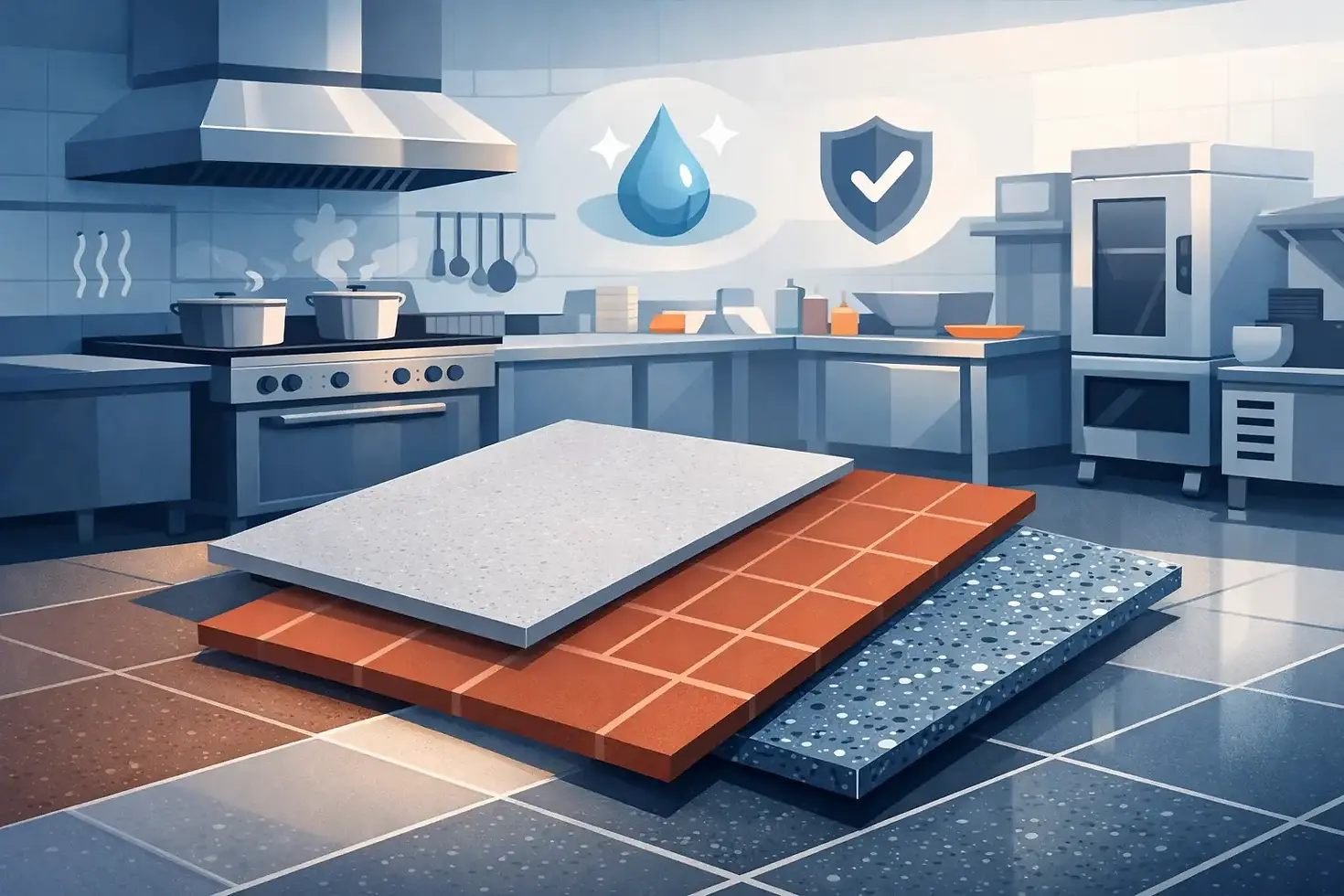
Epoxy-based and other resinous flooring systems are often among the strongest candidates for commercial kitchens, especially when the installation includes the right surface profile, slip-resistant aggregate, and integrated cove base. These systems create a continuous surface with fewer places for moisture and debris to collect.
For many operators, this is the practical middle ground between performance and cost. Resinous floors can be built to handle heavy traffic, daily cleaning, and exposure to grease and chemicals. They also support a cleaner look and easier maintenance compared with tile systems that rely on grout joints.
That said, not every epoxy floor is suitable for every kitchen. Standard epoxy may not be the best fit where thermal shock is severe, such as areas exposed to frequent hot-water washdowns or steam cleaning. In those conditions, other resin systems may perform better. Product selection and installation method matter as much as the category itself.
Quarry tile
Quarry tile has been used in commercial kitchens for decades because it is durable, heat-tolerant, and familiar to many design teams. When properly installed, it can hold up well under demanding conditions and provide solid slip resistance.
Its biggest drawback is the grout. Grout lines create more maintenance, more cleaning labor, and more opportunities for staining or failure over time. If drainage and slope are not handled correctly, tile systems can also become difficult to keep truly sanitary. Quarry tile remains a viable option, but it is rarely the lowest-maintenance one.
Urethane cement systems
In heavy-duty kitchens, urethane cement is often considered one of the highest-performing options available. It is especially useful where thermal shock, moisture, and aggressive cleaning cycles would challenge a basic resin floor. It can tolerate harsh service conditions and generally performs well around cook lines, dish areas, and processing zones.
The trade-off is cost. Urethane cement systems typically require a higher initial investment, but they may reduce long-term disruption in kitchens that simply punish conventional flooring. For facilities where downtime is expensive, that calculation often favors the stronger system.
Slip-resistant sheet vinyl
Sheet vinyl is not usually the first choice for a back-of-house commercial kitchen, but it can work in lighter-duty food service areas, break rooms, or support spaces where conditions are more controlled. It is easier to clean than many jointed surfaces and can offer decent water resistance when installed correctly.
Still, it is not built for the same abuse as heavy-duty resinous or quarry tile systems. In a full production kitchen with heat, grease, dropped equipment, and constant washdown, sheet vinyl may become a short-term answer instead of a durable one.
The subfloor and slope matter as much as the finish
When kitchen flooring fails, the visible surface often gets blamed first. In reality, many failures start below it. Moisture in the slab, poor substrate preparation, weak patching, or incorrect slope to drain can compromise even a good flooring product.
This is especially important in older New England buildings, where existing conditions can vary widely from one room to the next. A floor that looks flat may not drain correctly. A slab that seems dry may still have moisture issues. A busy renovation schedule may pressure the team to install before the substrate is ready.
The best commercial kitchen flooring system only performs as well as the surface beneath it. That is why experienced contractors spend time evaluating slab condition, drain locations, transitions, and the operating demands of the space before recommending a solution.
How to choose the right floor for your kitchen
The right decision starts with the use case, not the catalog. A kitchen serving a few hundred meals a day has different flooring needs than a hospital kitchen operating across shifts or a restaurant with constant fryer and grill traffic.
Start by looking at water exposure. If the kitchen uses regular washdowns, floor drains, and wet cleaning methods, a seamless resin or urethane-based system usually deserves serious consideration. If moisture is limited and sanitation protocols are lighter, other options may work.
Then consider thermal conditions. Areas near cook lines, steam equipment, and dish stations create stresses that some flooring systems handle better than others. Next, look at traffic and load. Rolling racks, carts, and point loads from equipment can wear out a light-duty floor quickly.
Maintenance should also be part of the decision, not an afterthought. A floor that is easy to clean but hard to repair may still be a problem. A floor with excellent durability but ongoing grout maintenance may strain labor over time. The best choice is often the one that balances performance, cleanability, and realistic upkeep for your staff.
Installation timing and operational disruption
Flooring selection is only half the job. In occupied buildings, the installation plan can be just as important as the material. Kitchens often have narrow shutdown windows, health and safety requirements, and tight coordination with other trades.
That is where commercial experience makes a difference. Proper sequencing, moisture testing, substrate prep, cure times, and return-to-service planning all affect the result. A floor installed on schedule but rushed through prep work can become a much bigger problem a few months later.
For facility teams, the safer approach is to work with a contractor who understands compliance-driven environments and can plan around active operations, night work, or phased construction. That kind of discipline protects both the flooring investment and the kitchen schedule.
Common mistakes when selecting commercial kitchen flooring
One common mistake is choosing based on upfront cost alone. Another is specifying a material without matching it to actual cleaning methods and kitchen conditions. A third is overlooking edge details, drains, and transitions, which are often the first places failures show up.
Slip resistance can also be misunderstood. More texture is not always better if it traps grease and makes cleaning harder. The goal is a surface that provides traction while remaining maintainable. That balance depends on the kitchen, the cleaning program, and the finish selected.
It is also a mistake to treat kitchen flooring like standard commercial flooring. Office-grade products and general-use finishes may look acceptable at turnover, but they are not designed for the abuse a working kitchen creates every day.
A practical recommendation
If you are evaluating the best commercial kitchen flooring for a high-demand environment, start with heavy-duty resinous systems, especially epoxy or urethane-based options designed for food service use. They typically offer the right mix of sanitation, durability, and cleanability when properly specified and installed. Quarry tile still has a place, particularly where teams are comfortable with its maintenance needs, but many facilities now prefer seamless systems because they reduce joints and simplify cleaning.
In the Boston area, older buildings, compliance requirements, and tight project schedules make proper evaluation even more important. Contractors such as Otis Flooring that work across complex commercial environments understand that kitchen flooring is not just a finish trade scope. It is part of how the facility operates every day.
The floor under a commercial kitchen should do its job quietly. If staff can move safely, cleaning crews can keep it sanitary, and managers are not calling for repairs every few months, that is usually the right floor.


Comments